 English
 Español
 Русский
 Français
 Deutsch
 عربي
 中文
A hemodialysis center, commonly known as a "kidney dialysis center," uses artificial kidneys (dialyzers) and hemodialysis machines to remove waste and excess water from patients' blood to help patients maintain their lives.
In such an environment, there are three key environmental factors that are closely related to patient status and equipment operation: temperature, humidity, and carbon dioxide concentration. To ensure accurate monitoring and rapid response to fluctuations, leading dialysis centers are adopting real-time environmental data loggers for regulatory compliance.
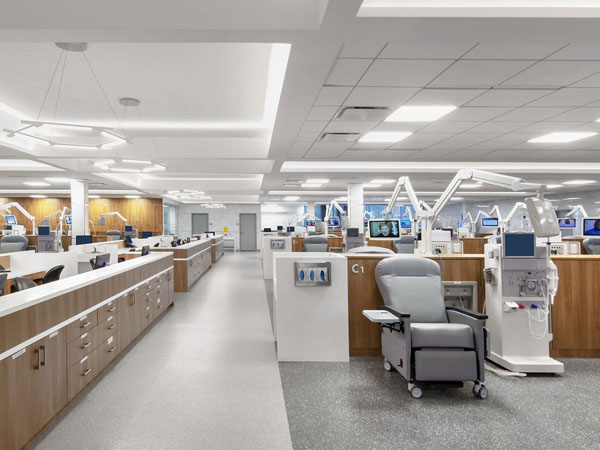
This article will introduce in detail the selection criteria for real-time environmental monitoring for hemodialysis centers.
The Importance of Environmental Data Monitoring in Dialysis Centers
Since most kidney failure patients visit the center for treatment three times a week, with each session lasting approximately four hours, monitoring of environmental temperature and humidity in the center, as well as carbon dioxide levels, will have an impact on the treatment process and the comfort of the patient and the therapist. In addition, the center's medical equipment and environment may be damaged or accelerated due to improper environmental data.
Environmental standards for hemodialysis centers
For patients and medical staff, keeping the temperature between 20℃ and 24℃ can avoid improper treatment results for patients due to low temperature, and dialysis machines and other equipment can also reduce overheating; maintaining the relative humidity between 30% and 60% RH can effectively reduce static electricity caused by moisture and drying. Indoor CO₂ concentration within 1,000 ppm can effectively reduce the increased chance of respiratory cross-infection due to poor ventilation.
Considerations for Selecting a Real-time Environmental Data Logger
1) Multi-channel probe: An environmental recorder that supports multiple monitoring parameters can help medical staff reduce the difficulty of point layout and the risk of data dispersion.
2) Optional communication methods: Due to the privacy of medical information, WiFi or LAN communication equipment may take longer to install when connected to the institution's intranet and cannot be updated in time during hospital network maintenance or disconnection. The equipment supported by 4G communication has fewer restrictions and more freedom.
3) Data integration capability: Since most dialysis centers use third-party data integration platforms or their own data integration platforms, if the recorder manufacturer does not support data integration into the central platform, it will add a lot of unnecessary data verification work to medical staff and increase the speed of delayed response to notifications.
4) Battery life: Battery life is also an important criterion for selection. Reliable battery life can reduce the number of equipment maintenance times.
Recommended Real-time Environmental Data Logger for Hemodialysis Centers
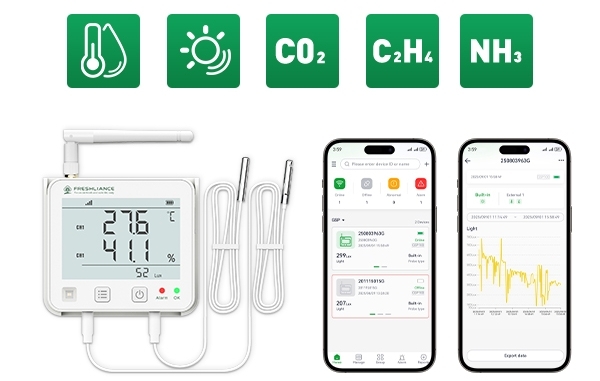
The Freshliance GSP 100-4G real-time environmental data logger supports 24/7 continuous real-time environmental monitoring. Two optional external high-precision probes support simultaneous monitoring of temperature, humidity, and carbon dioxide. At the same time, the cloud platform supports third-party platform integration services such as API or WEBHOOK to help dialysis centers ensure data privacy and compliance. In addition, the GSP100 WiFi/4G wireless temperature logger supports 5V/2A DC power input through a USB Type-C interface and uses a rechargeable and replaceable high-capacity lithium battery as the backup power.