 English
 Español
 Русский
 Français
 Deutsch
 عربي
عربي 中文
中文For many cold storage operators, the logic is simple: if the cooling system is running and the thermostat says -18°C, the job is done. However, your electricity bill often tells a different story. In 2026, as energy costs climb and ESG standards tighten, the "set-it-and-forget-it" approach is no longer sustainable. A wireless temperature data logger is no longer just for compliance—it is an essential tool for cost recovery.
1. Eliminating the "Sawtooth" Efficiency Drain
When you analyze data from an independent logger, you often see a "Sawtooth Curve"—readings that spike and dip aggressively. This is a clear symptom of Short Cycling.
What is Short Cycling?
It refers to the compressor (the cooling engine) turning on and off too frequently. Compressors are heavy-duty machines that draw 5 to 7 times their normal running current just to start up. If the compressor "sprints" (turns on) for 5 minutes and then "rests" (turns off) for 5 minutes, it consumes massive amounts of electricity during those constant restarts.
The Culprit:
Most cold storage rooms come with a native temperature control sensor hardwired to the refrigeration system. Poor placement of this probe—such as mounting it directly in the path of cold airflow—can create major operational issues. It will falsely read the space as fully chilled right away, causing the compressor to shut down too early. Seconds later, warmer air from the back of the room hits the probe, and it kicks the compressor back on.
By using independent Freshliance wireless temperature data loggers to identify these "sawtooth" patterns, you can recalibrate your control logic. Moving from erratic "sprints" to steady "marathons" can reduce energy consumption by up to 15%.
2. Identifying "Hot Spots" via Thermal Mapping
A cold room is never a uniform cube of ice. Pallet placement, door seals, and structural dead zones hinder airflow, creating pockets of stagnant air.
The Risk: Most thermostats rely on a single built-in sensor. If that sensor sits in a "cold pocket," the rest of your facility might be dangerously warm. Conversely, if it’s in a "hot spot," the system overworks itself to cool a corner that doesn't even need it.
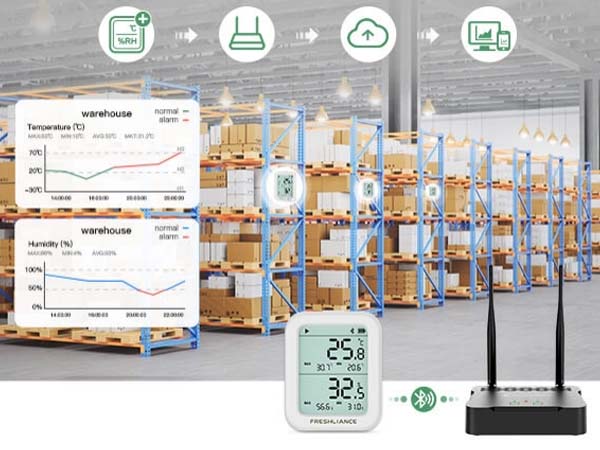
The Solution: You need Thermal Mapping. By outfitting your racks with an array of BlueTag TH30R Bluetooth temperature sensors, you gain clear visibility of temperature conditions at every level and corner across your storage zones.
The Result: Real-world data frequently shows that simple adjustments—like reorganizing cargo or tweaking baffle settings—make it possible to bump up the overall temperature setpoint by 1°C to 2°C without compromising product safety. For large facilities, this minor tweak cuts thousands in yearly cooling expenses.
3. Fighting Produce Shrinkage to Protect Profits
Humidity quietly eats into your bottom line, hitting high-value fresh goods like blueberries and leafy greens especially hard. Unstable temperature levels pull moisture out of fresh produce, which then builds up as frost on evaporator coils.
In the industry, we call this "Shrinkage." If a pallet of strawberries suffers a 3% weight drop from moisture sublimation, you’re essentially letting 3% of your saleable stock escape into the air. On top of that, frost accumulating on cooling coils forces the system into frequent, power-hungry defrost cycles. By consistently tracking humidity and temperature in real-time, you can maintain that ideal storage balance—preserving your fruit’s weight and protecting your bottom line.
The Freshliance Edge: Real-Time Operational Intelligence
A wireless temperature data logger shouldn't just tell you that your cargo spoiled "after" the fact; it should provide the diagnostic data to prevent mechanical waste today.
To manage a complex facility efficiently, we recommend a centralized ecosystem:
BlueTag TH30R: High-precision Bluetooth temperature sensors designed specifically for the rigors of cold storage.
G1000 Bluetooth Gateway: Automatically collect and upload data from every sensor in the room to the cloud, eliminating manual check-ups and consolidating all logs together.
This setup allows you to visualize "invisible" energy leaks in real-time from your office, without ever opening the cold room door. Stop guessing your cold room’s performance. Start measuring it.